Chit Chat
There is currently 1 person viewing this thread.

30 Dec 14
15:40
Joined:
Date Joined:
27 May 11

sort by:
Show
per page
Replies: 18
|
By:
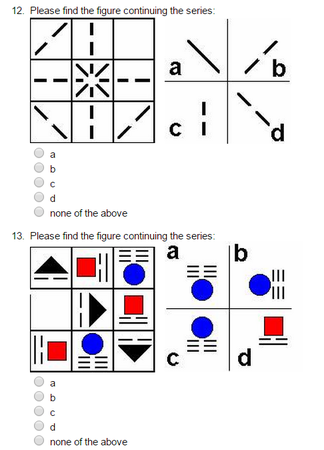
D, none of the above, a, d, not sure, d.
Unless it is a trick and they are all d's. |
|
By:
d
b c (?) d c d |
|
By:
Actually 13 is a
|
|
By:
d
a n d a. |
|
By:
d
b a d c d |
|
By:
d
b none d b d |
|
By:
d
b a d c d |
|
By:
Why?
|
|
By:
d
b none d c d |
|
By:
d
b none d C (change of mind!)  d |
|
By:
d
b a d c d |
|
By:
The correct answers are
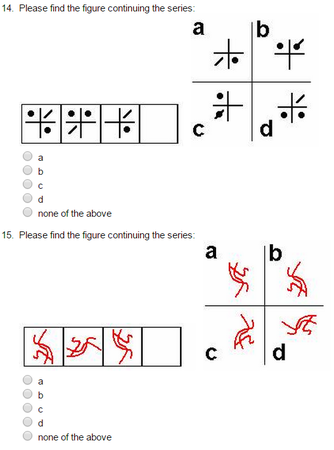
Well done ken masters, only one to get them all right. D B C D C D |
|
By:
Explanation required for Q14.
|
|
By:
Yeah, What's 14 please???
|
|
By:
I think the way #14 works is as follows:
At each step the black spot in the top left quadrant is rotated anticlockwise through three quadrants and the other two symbols are rotated anticlockwise through two quadrants. Therefore in the third figure the black dots are superimposed and in the fourth figure the dash and dot are superimposed,which gives figure C as the answer. |
|
By:
You can achieve the same result by rotating one dot clockwise 1 quadrant and the other two symbols each 2 quadrants clockwise at each step in the sequence. It amounts to the same solution.
|
|
By:
that works too foinavon but the way it is, is the ball in the top left corner rotates once clockwise, whilst the other ball and line move diagonally back and forth to produce option C, the other three options provide no continuous pattern
|
|
By:
I got
12. d), 13. b), 14. None of the Above, 15. d) 16. c) 17. d) 14. is a tricky one even with the explanations above. I wouldn't have ever got it. |